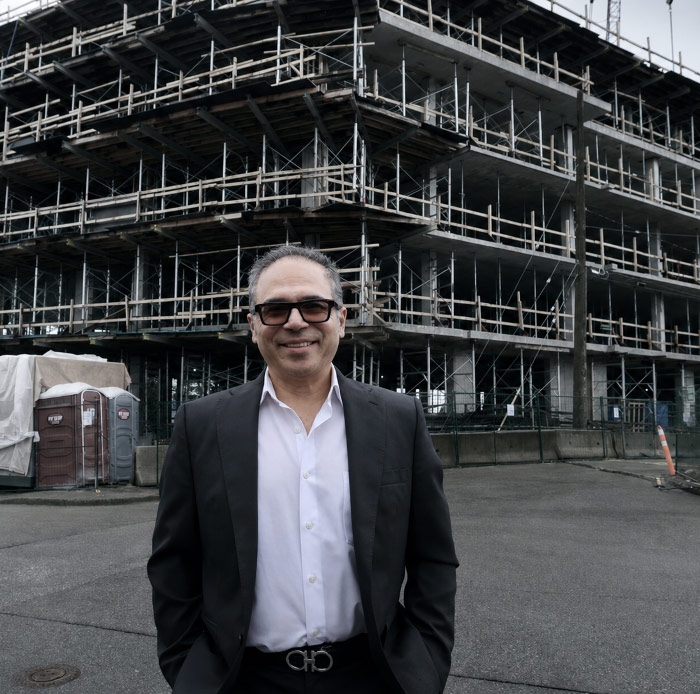
Adapted from reporting originally published by the Vancouver Sun on March 4, 2024, by Lori Culbert.
With home prices making it increasingly difficult for many British Columbians to enter the housing market, rent-to-own has emerged as one potential way to help prospective homeowners overcome one of the biggest barriers to purchasing a home: saving for a down payment while continuing to pay rent.
In its examination of rent-to-own housing in British Columbia, the Vancouver Sun highlighted an innovative program created by Cascadia Green Development and Community Savings Credit Union at INNOVA in North Vancouver.
The pilot demonstrated how collaboration between developers, financial institutions and other levels of support could create an alternative route to homeownership, while also illustrating some of the financial challenges involved in expanding rent-to-own programs across the province.
A Different Approach to Homeownership in B.C.
In a traditional home purchase, buyers generally need to accumulate a significant down payment before qualifying for financing and taking possession of their home.
That can be particularly difficult in Metro Vancouver, where prospective buyers may already be spending a substantial portion of their monthly income on rent.
Rent-to-own changes that sequence.
Instead of requiring prospective homeowners to save their full down payment while renting elsewhere, a rent-to-own arrangement allows participants to occupy a home for a defined period while some or all of their payments are applied toward eventually purchasing the property.
The model has attracted attention as policymakers, developers and financial institutions explore different ways of addressing housing affordability and helping people move from renting into ownership.
Cascadia Green Development’s Rent-to-Own Pilot at INNOVA
The Vancouver Sun highlighted INNOVA in North Vancouver as a real-world example of the rent-to-own concept being put into practice.
The program was developed through a partnership between Cascadia Green Development and Community Savings Credit Union and initially made eight homes at INNOVA available through a rent-to-own structure.
The initiative was particularly focused on helping people who had the income required to carry the cost of a home but faced difficulty accumulating the down payment necessary to enter the ownership market.
Priority was given to first responders and people who lived or worked in the City of North Vancouver, connecting the program with the broader goal of helping members of the local workforce remain in the community where they worked.
How the INNOVA Rent-to-Own Program Worked
Under the original structure, shortlisted applicants entered into a purchase and rental agreement.
Participants initially contributed $5,000, establishing the agreement and locking in the purchase price of the home.
A further $5,000 was paid when the participant received the keys.
The participant would then live in the home and pay market-rate rent for two years.
Importantly, the rent paid during those two years was not simply treated as a conventional housing expense. Under the program, the rental payments, together with the initial payments, were credited toward the participant’s eventual down payment.
The model effectively gave qualifying residents two years to transition toward homeownership while already living in the property they intended to purchase.
More Than 700 Applications for Eight Homes
Demand for the program demonstrated how significant the challenge of accumulating a down payment had become.
According to the Vancouver Sun, more than 700 potential buyers applied for the eight homes made available through the original INNOVA rent-to-own initiative.
That level of interest highlighted a gap in the market.
Many prospective homeowners may have steady employment and sufficient income to make significant monthly housing payments, yet still struggle to accumulate tens of thousands of dollars for a down payment while simultaneously paying high rents and other living expenses.
The INNOVA pilot was designed specifically around that problem.
Rather than asking whether a household could somehow save a down payment in addition to rent, the program explored whether the rent they were already capable of paying could help them progress toward ownership.
Supporting North Vancouver’s Local Workforce
The initiative also addressed another housing challenge affecting communities such as North Vancouver: the difficulty many essential and local workers face living close to their workplaces.
When homeownership becomes increasingly inaccessible, workers can be pushed farther away from the communities they serve.
That can affect first responders, health-care workers, teachers, municipal employees and other professionals whose employment is closely connected to a particular community.
By prioritizing first responders and people who lived or worked in the City of North Vancouver, the INNOVA program connected homeownership with the idea of workforce housing.
The concept was consistent with housing needs previously identified by the City of North Vancouver, including the need to explore transitional forms of housing such as rent-to-own, co-ownership and local workforce housing.
Rent-to-Own Enters B.C.’s Housing Debate
The Vancouver Sun article placed the Cascadia initiative within a broader provincial discussion about rent-to-own housing.
At the time, then-B.C. United leader Kevin Falcon was proposing expanded government support for rent-to-own developments as part of his party’s approach to housing affordability.
One example outlined in the article considered a buyer renting a $900,000 home for $3,000 per month for three years.
Over that period, the payments would total approximately $108,000, which could then be applied toward purchasing the home.
The idea was that government support could help developers carry the cost of participating homes during the rental period, making it more financially practical for developers to offer rent-to-own opportunities.
Why Rent-to-Own Can Be Difficult for Developers
Although the model can help address the down-payment barrier for buyers, the Vancouver Sun also examined why rent-to-own is not necessarily easy to deliver at scale.
For a developer, a completed condominium is normally sold and the proceeds are used to repay construction financing and other project costs.
Under rent-to-own, however, the developer may need to retain ownership of the property for several additional years while the eventual buyer occupies it.
This means capital remains tied up in the property.
When borrowing costs and interest rates are high, carrying a completed home for an extended period can become significantly more expensive.
That financial reality helps explain why rent-to-own programs have historically remained relatively uncommon and why developers may require partnerships, financing arrangements or government participation to make larger programs economically viable.
The Role of Government and Financial Institutions
The INNOVA pilot demonstrated the importance of collaboration.
Rather than Cascadia Green Development attempting to create the program independently, the project brought together a developer and Community Savings Credit Union, combining housing development expertise with financial-sector participation.
Government programs were also exploring ways of supporting this housing model.
In Budget 2022, the federal government allocated $200 million over five years to a dedicated rent-to-own stream under the Affordable Housing Innovation Fund, designed to develop and test new rent-to-own models across Canada.
The objective was not only to assist individual purchasers, but also to determine whether innovative ownership models could be expanded and replicated.
The INNOVA initiative became an example of how the private sector and financial institutions could work together to test a different route into homeownership.
Rent-to-Own Addresses One Part of the Housing Problem
The Vancouver Sun’s examination also made an important distinction: rent-to-own is not a complete solution to B.C.’s housing affordability crisis.
Helping a purchaser accumulate a down payment does not necessarily make the underlying price of a home affordable.
A household that successfully builds a down payment must still qualify for the mortgage required to complete the purchase and must be able to carry mortgage payments, property taxes, strata fees, insurance and other ownership expenses.
Rent-to-own therefore primarily addresses the transition from renting to owning and the challenge of accumulating upfront equity.
It does not independently solve broader issues involving housing supply, construction costs, land prices, borrowing costs or household income.
That distinction is important when considering where rent-to-own fits within a larger housing strategy.
Innovation Through the INNOVA Pilot
For Cascadia Green Development, the INNOVA rent-to-own initiative represented an opportunity to test a new housing model rather than relying solely on the traditional presale and home-purchase process.
The program showed that there was significant demand for alternative approaches to ownership, with more than 700 applicants competing for just eight initial opportunities.
It also demonstrated the potential benefits of collaboration among developers, credit unions, governments and municipalities.
For Cascadia Green Development founder and CEO Farzad Mazarei, the initiative formed part of the company’s broader effort to participate in discussions around creative responses to British Columbia’s housing challenges.
The pilot placed North Vancouver and INNOVA at the centre of a wider conversation about whether innovative ownership structures can help more working residents remain in the communities where they live and work.
A Model With Potential and Limitations
Rent-to-own offers an appealing proposition: allow residents to put money they would otherwise spend entirely on rent toward the possibility of owning their home.
For the right household and under the right financial structure, that approach can help overcome a significant barrier to homeownership.
The experience at INNOVA demonstrated the demand for such an option and provided a practical example of how a developer and credit union could implement it.
At the same time, the broader discussion highlighted by the Vancouver Sun shows that scaling rent-to-own requires more than buyer interest.
Financing costs, mortgage qualification, developer economics and government policy all influence whether these programs can become widely available.
Rather than serving as a single answer to British Columbia’s housing crisis, rent-to-own can therefore be viewed as one tool within a much broader housing strategy.
For Cascadia Green Development, the INNOVA pilot demonstrated what can be achieved when the real estate industry looks beyond conventional housing models and explores new partnerships and new paths to ownership.
Source and Attribution
This article is adapted from reporting originally published by the Vancouver Sun:
“Why rent-to-own is (and isn’t) one solution to B.C.’s housing crisis”
By Lori Culbert
Published March 4, 2024
Original source:
https://vancouversun.com/business/real-estate/bc-rent-to-own-homes
Original reporting and source material: Vancouver Sun / Postmedia Network Inc. Adapted for the Cascadia Green Development website with attribution to the original publication.